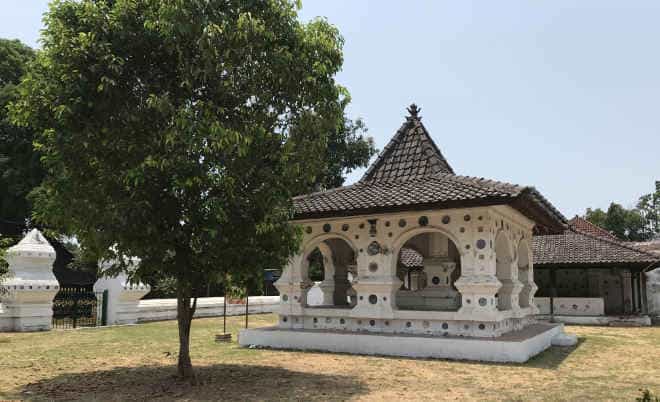
Taman Prasasti museum, located in central Jakarta, features the remains of a former cemetery built by the Dutch colonial government in 1795 as a “resting place for noble dutchmen”.
Originally 5.9 hectares in size only 1.3 hectares remains as the largest part of the land was used for the construction of the Central Jakarta Mayoralty offices in 1975. Of an estimated 4,200 tombstones that were originally located there only 1,372 now remain - some of the corpses were removed by relatives (upon request by the local government) while others were relocated to Tanah Kusir cemetery in South Jakarta.
Taman Prasasti (which literally translates to inscription garden in Bahasa Indonesia) is now an outdoors museum whose notable interments include:
- Olivia Marianne Raffles - wife of Sir Thomas Stamford Raffles;
- Jan van Hoorn - former governor-general of Batavia;
- Soe Hok Gie - Chinese-Indonesian activist
Despite being originally designated a “resting place for noble dutchmen” Taman Prasasti also contains the resting places of native Indonesian, British and American residents too.


Within the grounds of the museum are the original coffins for the first president and vice-president of Indonesia: Sukarno (buried in the city of Blitar, east Java) and Mohammed Hatta (buried in Tanah Kusir public cemetery, South Jakarta).


The resting place of Soe Hok Gie - a Chinese-Indonesian activist who actively opposed the Sukarno and Suharto governments:

Marius Hulswit (1862-1921), architect of Jakarta’s Neo-Gothic Cathedral is interred here:

First impressions
The grounds of the museum are quite tranquil and relaxing with an initial courtyard featuring a series of monuments as well as replicas of a 17th Century hearse.

There are a series of paths that allow the visitor to explore all corners of the cemetery where, along the bordering walls, they will be greeted by many old tombstones forming part of the enclosing structure.
Many grand and varied monuments are contained within the ground of the museum although it is somewhat disappointing to see how neglected many of the resting places within the cemetery appear to be.
Broken tombstones are quite common and I even noticed what appeared to be some graffiti on one of the marker stones embedded in the far wall which was dispiriting. How anyone can wilfully deface such a monument is beyond my ability to comprehend. Whatever your beliefs on the subject of religion/the afterlife the resting places of the dead should nevertheless be treated with a decent amount of respect.


I discovered that the graveyard is also a surprisingly popular place for photo-shoots although I felt somewhat uneasy and annoyed by the lack of reverence shown with many of the costumes/themes of the 2 - 3 separate photoshoots that I witnessed whilst visiting.
Seeing young women dressed in outfits more akin to some gothic style fantasy while being eagerly photographed by their noisy male colleagues was really not appropriate to that location. Of all the places they could have chosen it was sad to see the resting place of the dead being treated so frivolously.


These minor quibbles aside I was very surprised how peaceful and relaxing the open grounds of the museum were considering that this is situated within central Jakarta (with its chaotic traffic and constant background noise). The layout of the resting places within the museum grounds afford ample room for movement, with wide paths allowing for unhindered navigation of the site, as well as time and space for observation/contemplation of the various monuments located there.


As an added bonus the shade from the many trees situated there provides some much needed and very welcome protection/respite from the heat of the sun (which seems to tax even native Indonesians who I would have thought hardened to that climate…..an observation that makes this ‘bule’ feel less soft and fragile! :D).
It would be great if there were further renovation work undertaken within the museum grounds to restore those broken graves as well as find a way to possibly accommodate the many gravestones that have been left discarded and damaged near to the side of the courtyard near the entrance.


I don't know how easy, if at all possible, it would be to repair and accommodate these "abandoned" gravestones but it's a shame to see them languishing in such a neglected and broken state.
Getting there
The museum itself is easily reachable by public transport or on foot and is only a few streets away from the National Museum and Monas.
Fee
I can’t recall what the entry fee for visiting Taman Prasasti actually was but I seem to recall that it was quite cheap. If you happen to be staying in Jakarta for any length of time this is an interesting and quite tranquil location to spend a couple of hours visiting.