

Indonesia contains many sights and monuments of historical interest that can, bizarrely, be overlooked or not even noticed - many times thanks to urban planning (or, I strongly suspect, the lack of such planning).
This was almost the case with Tugu Muda, a monument to commemorate the sacrifices of the youth who fought against the Japanese military during the five day battle of 14th - 19th October 1945 (also known as the Battle of Semarang).
Why the city planners decided to situate this important historical monument in the middle of a roundabout on an extremely busy road system with NO bridges nor means for visitors to safely reach that sight is mind boggling.
As much as I love Indonesia the planning of urban areas seems to consist of absolutely zero regard for pedestrian movement whatsoever. Paths are often incomplete, damaged or blocked in some way, shape or form by building structures or other immovable objects. Who plans this? Is there any planning at all? It certainly doesn’t seem that way a lot of the time.
Case in point: the only way to get to Tugu Muda is to navigate pauses in the traffic and cross the wide road system to reach the traffic island where the monument is situated. As you might appreciate this is not only VERY dangerous but also ridiculous and, let’s be brutally honest here, not the best way to honour the bravery of youths who sacrificed their lives to defend their homeland.
Why put a monument of such historical importance in the middle of a busy road system and make it as difficult as possible to get to? Good one guys, now pick up your bonus for such an inspired decision…
A little background information
As is often the case with the history of many sights of cultural and historical importance in Indonesia the story of the monument is quite tragic and filled with much bloodshed. Semarang, like the rest of Indonesia, was occupied by the Japanese during World War 2 and saw many natives lose their lives at the hand of their occupiers.
Estimates of the Indonesians who lost their lives during the Battle for Semarang range from less than 300 to around 2000 (which is quite a disparity in figures). Unfortunately I have been unable to research the battle in depth to ascertain what the likely number of casualties were. Regardless, it was yet one more bloody chapter in Indonesia’s post World War 2 history and is commemorated at Tugu Muda (Indonesian for Youth Monument).

Tugu Muda is free to visit (providing you can safely navigate the road and avoid being hit by the insane amount of traffic passing around that part of the city) and consists of an ornamental pond, gardens and a monument.


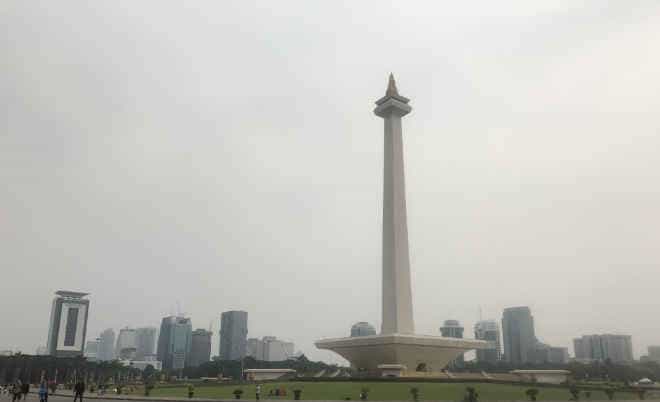
The monument itself consists of a relief-covered base, depicting scenes from the Battle of Semarang supporting a column with what looks like a flame carved at the top.
The gardens are quite beautiful and it’s not unusual, during the evening, to see young couples sat on the benches there enjoying the peacefulness of that location (despite being in the middle of a busy road system the traffic at that time of day is much more subdued).

A small noticeboard near the monument informs the visitor, in both Bahasa Indonesia and English, of the history behind the monument.
This is quite a beautiful location to visit during the early to mid-evening hours, as the monument is lit up with a rotating light show of different colours, but getting there - as stated earlier - can be tricky. If you’re looking to visit Tugu Muda when in Semarang just be aware of this!
Getting there
Tugu Muda is reachable by foot and is situated in the centre of the roundabout where Jl. Pandanaran, Jl Pemuda, Jl. Imam Bonjol and Jl. Mgr Sugiyopranoto converge - directly opposite famous landmark building Lawang Sewu.




Post a comment
All comments are welcome and the rules are simple - be nice and do NOT engage in trolling, spamming, abusiveness or illegal behaviour. If you fail to observe these rules you will be permanently banned from being able to comment.