
Located on a plateau about 3km south of Prambanan temple Ratu Boko appears to be the remains of a settlement dating from around the 9th Century AD. Hinduist/Buddhist artefacts have been found at this site which suggest that the two religions may have co-existed within the same location although I have read that there appears to be no consensus on the precise function of the site.
One theory contends that Ratu Boko may have been a former palace from the Medang Empire (alternatively known as the Mataram Kingdom) which was a Javanese Hinduist-Buddhist kingdom that flourished between the 8th and 11th Centuries and ruled by the Sailendra dynasty.
Other scholars speculate that the site was used as a monastery while others contend that it simply functioned as a site for rest and recreation.
There is a fascinating story from the Javanese Roro Jonggrang folktales concerning the origins of Ratu Boko temple and how the Princess Rara Jonggrang is thought to be connected with the statue of Durga Mahisasuramardini located in the Shiva temple at Prambanan.
Whatever the truth of Ratu Boko’s original function was nobody yet knows but the different theories and folktales do make for interesting and entertaining reading.
Ratu Boko
The settlement complex consist of a number of structures/sites, some of which are listed below:
- gopura
- paseban
- pools
- pendopo
- kaputren
- Candi Pembakaran
- meditation caves
In addition to these clearly defined locations there are also a number and variety of scattered ruins which, in addition to the remains of the previously mentioned locations/features, can only leave one speculating as to what they once belonged to and how the settlement must have looked in its former glory.
If only we could rewind time and find out!
Entry to the settlement takes the form of climbing a series of steps up a steep hill before following a winding path - this journey will take the best part of 10 - 15 minutes - before finally arriving at the outer gate, or gopura, to the Ratu Boko complex.


Once you pass through the outer gate to Ratu Boko you’ll be greeted with 3 inner gates (gopuras) at the top of stairs:

Having passed through these (and be warned they might be heavily occupied with various visitors taking selfies!) you are now inside the grounds of what was the settlement. This spans some 250,000 square metres so be prepared to spend a couple of hours here walking around visiting the different locations.
Paseban
A paseban is a waiting area for guests who wish to meet the palace king. At Ratu Boko there is an eastern paseban and western paseban - both of which are facing each other. I’m not sure which is which but each paseban was in a very basic state as can be seen from the following photos:


Pools
There are various bathing pools that remain at the settlement; some varying in size and shape:


Pendopo
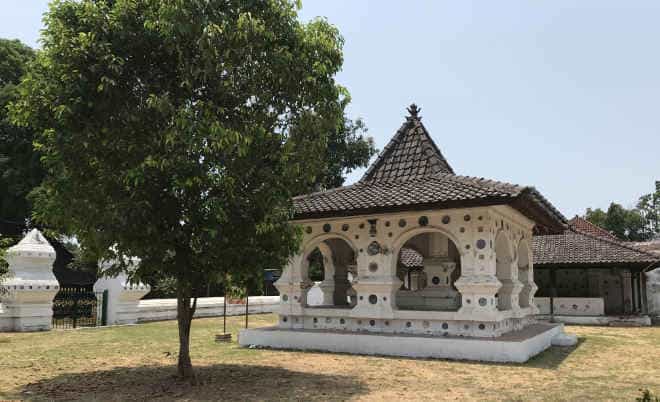
This was the location of the audience hall of the settlement and consists of a square stone enclosure surrounded by a stone wall with small paduraksa entrance gates located in the north, west and south sides. Within the walls of the pendopo is a stone base with two separated terraces which would have served as the base or floor of a wooden structure (long since decayed).


Kaputren
To the east of the pendopo on the lower terrace of the settlement is situated the Kaputren or women’s quarters along with pools believed to be the pleasure gardens for the king and his concubines.


Candi Pembakaran
This structure was believed to be used as a crematorium for the settlement

Goa
There are two caves located at Ratu Boko, which are isolated from the main settlement. The upper cave is called Gua Lanang (Male Cave) and the lower cave known as Gua Wadon (Female Cave). It is speculated that these were used for meditation.

I loved visiting Ratu Boko (although seeing many visitors simply using the various locations there to only take selfies instead of appreciating the beauty of the site and engaging with its history was tedious to endure) and was struck by just how large the settlement actually was.
One can only imagine what the location must have looked like in its full glory during the 8th - 11th centuries and how powerful the respective Javanese kingdoms must have been at their peak of their existence.
It’s somewhat sobering to consider how those once mighty kingdoms and empires are now nothing more than footnotes in history with sites like Ratu Boko to remind us of their temporary existence.
This does make you think though - how many powerful empires and mighty civilisations must once have emerged, flourished and disappeared only to be completely unknown and unheard of; having failed to leave any traces in the historical and archaeological records.
I’m confident that there’s a lot more of these forgotten empires and civilisations than we can even hint at and our understanding of history would be radically altered if even the slightest traces of their existence were to emerge.
Definitely food for thought...
Getting there
Getting to Ratu Boko, which is roughly 17km from Yogyakarta city centre, will involve one of 3 methods:
- Being part of a private tour
- Booking a taxi
- Relying on local friends (if you are fortunate to have any)
Your best bet, aside from having Indonesian friends who might be willing to drive there and accompany you for a day out (lucky if you do!), is to book a taxi service instead. When in Yogyakarta and the surrounding region I relied on using the GoCar app to book various taxi services as the fares are displayed up front at booking time and cars are usually widely available.
Be warned though you will be driving through some remote villages and traveling up winding roads on steep hills in order to reach this location (and there are some very interesting sights along the way) so don’t start to panic if you wonder where you are!
Fee
As expected foreign visitors are charged a higher ticket fee to gain entry to the site which, at the time of my visit during September 2019, was 337,500 Indonesian rupiah (roughly £18.60 in pounds sterling or $24.07 US dollars). I’m not sure what the non-foreign rates are but I’m certain they were much cheaper.




Post a comment
All comments are welcome and the rules are simple - be nice and do NOT engage in trolling, spamming, abusiveness or illegal behaviour. If you fail to observe these rules you will be permanently banned from being able to comment.