

When I was planning my trip to Yogyakarta there was one place that my Indonesian friends and acquaintances kept telling me I should visit: the Keraton.
The Keraton, often referred to as the Sultan’s Palace, is the home of Yogyakarta’s Sultan and is divided over 2 sites: Tepas Keprajuritan (army side) and Tepas Pariwisata (tourist side), both of which are open to tourists to visit (do note that in both locations a separate visitor fee is charged and if you are looking to take photographs - which is practically inevitable for all tourists - that an additional 1,000 IDR fee is also charged for each location).
Although much power has devolved from the Sultan since Indonesia’s independence from Dutch colonial rule they are still, by birthright, the automatic governor of the region and therefore responsible for helping to manage political and official matters within Yogyakarta.
Seeing the affection and high regard that the Sultan is held within by not only the tour guides and palace servants but also many local citizens that I spoke with is something to behold. It’s clear that he is well respected and loved by many native citizens that I met and this is an unusual phenomenon to witness for a Westerner accustomed to the openly cynical and often contemptuous attitudes expressed towards leaders in my home country.
Tepas Keprajuritan

Situated at the southern end of Alun-alun Utara square the Tepas Keprajuritan portion of the Keraton contains a variety of buildings including a formal ceremonial hall (Siti Hinggil) - which, interestingly, is where Soekarno, the first president of Indonesia, was enthroned.

There’s also a performance hall (Bangsal Pagelaran) where royal ceremonies, such as the Sultan’s coronation, and public performances are held.
Within the grounds of Tepas Keprajuritan you’ll also see the Sultan’s first car (I seem to recall my tour guide mentioning that this was a 1960’s American Ford but I’m no expert on the different makes and models of cars so, if I’m wrong on this topic, please feel free to correct me in the comments below).

Parts of the palace are off-limits to visitors as these are still occupied by the Sultan and his family although there are many buildings that you can visit within the compound.
These feature different aspects of the Keraton’s history, the cultural traditions and background information about the different events that are performed there.
As you walk around you'll be able to see the architectural features and styles used within the buildings which appear to be a blend of native Javanese with Dutch colonial.


I found the sculptural reliefs adorning the walls leading up to one of the main buildings of the complex quite interesting as these appeared to tell the history of Yogyakarta and the Sultan’s role over the course of recent centuries.


The museum building that featured photographs or paintings/illustrations (if predating the invention of photography) of each Sultan who has held the throne in Yogyakarta was definitely an eye-opener for this Westerner. Underneath each depiction of the Sultan for that era was some associated background information. Learning just how many wives and children some of these rulers had was mind-boggling. I believe one of the Sultans had 24 wives while Sultan Hamengku Buwono VII had 78 children!!!

It’s fair to say that even the most ardent practitioners of polygamy in the West cannot hold a candle to the appetites of some of the former Sultans of Yogyakarta!
As you enter the gates for the Tepas Keprajuritan portion of the Keraton and pay your entrance fee/camera charge you will also have the opportunity to take on a guide for a tour around the complex.
I would recommend you take this opportunity as you will learn many interesting facts about the palace and the Sultan during your visit.
Tepas Pariwisata

The “second” part of the Keraton complex (depending on whether you visited Tepas Keprajuritan first or not) is located in Jalan Rotowijayan No.1, Panembahan, Kecamatan Keraton.
The entrance fee costs 15,000 IDR with an additional 1,000 IDR fee for taking photographs.

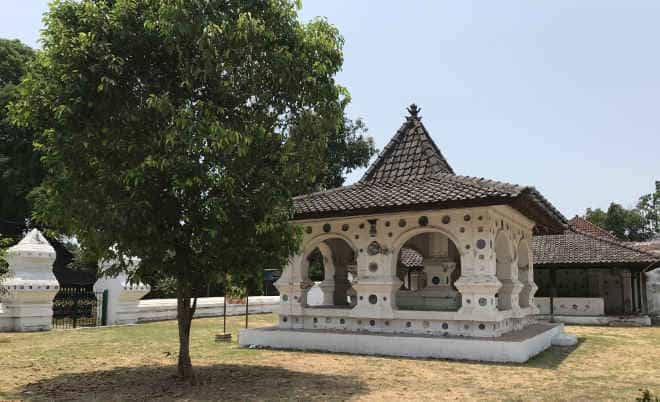
The Tepas Pariwisata complex consists of a number of pavilions, halls and museum buildings where historical and cultural artefacts relating to the Sultan such as furniture, batiks and photographs are displayed for visitors to see.


The museum building featuring photographs, costumes and other belongings from the previous Sultan who died in 1988 was quite fascinating to visit. Here was a whole lifetime, spanning from his earliest days to his funeral procession, compressed into a hall of artefacts.

The sacred banyan trees

There is a popular legend that states those who are able to walk blindfolded, without mishap, between the two sacred banyan trees in Alun-alun Utara square will receive good fortune in their life.
I didn’t have a blindfold but I did manage to do this with my eyes closed…..now I’m waiting for that financial windfall to come my way! :D
Be mindful though when walking along the path that leads through these trees as it is very dusty and quite unpleasant when the wind picks up. Given the generally poor air quality in Indonesia I would advise wearing a mask, particularly when venturing outdoors.
Fee
I seem to remember that entry to both Keraton locations cost 15,000 IDR with an additional 1,000 IDR fee for taking photographs.
Getting there
Both sites are easily accessible by public transport or walking.




Post a comment
All comments are welcome and the rules are simple - be nice and do NOT engage in trolling, spamming, abusiveness or illegal behaviour. If you fail to observe these rules you will be permanently banned from being able to comment.